


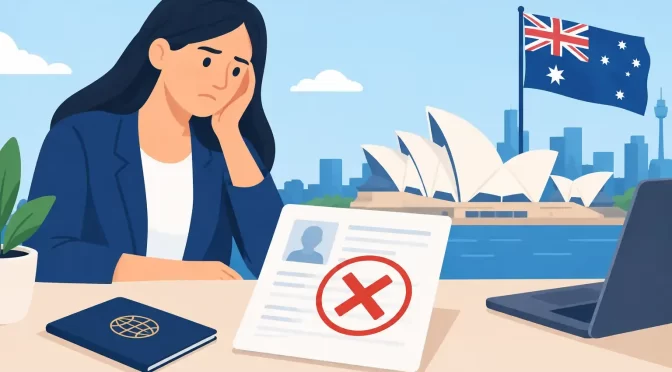
A visa refusal can put study plans, a new job, time with family, or a long-planned move to Australia on hold. The top reasons visa applications fail are rarely just about one missing paper. More often, the application does not clearly prove that the applicant meets every relevant legal requirement.
Australian visa applications are evidence-based. A genuine situation may still lead to a refusal if the information is inconsistent, documents are incomplete, or the explanation does not address what the Department needs to assess. Careful preparation before lodgement gives you the best opportunity to present your circumstances clearly and confidently.
The top reasons visa applications fail
The applicant does not meet the visa criteria
Every visa has its own requirements, and meeting one part does not automatically satisfy the whole application. A student visa applicant may have a valid Confirmation of Enrolment but provide weak information about their financial capacity. A partner visa applicant may submit many photographs but not enough evidence of a genuine, ongoing relationship. A skilled visa applicant may have relevant work experience that does not meet the required occupation, skills assessment or points criteria.
The key is to assess eligibility before making plans around an outcome. Visa rules can turn on details such as age, work history, English language results, health, character, sponsorship obligations, location at the time of application, and timing. If there is uncertainty, it is better to identify it early than attempt to explain it after a refusal.
Incomplete, incorrect or inconsistent documents
Documents tell the story of an application. If that story has gaps or conflicting details, a decision-maker may question whether the claims can be relied upon. Common issues include incomplete forms, expired identity documents, missing certified translations, dates that do not align, and bank statements that do not support declared income or savings.
Inconsistencies are particularly risky when they appear across forms, personal statements, previous visa applications and supporting evidence. For example, a visitor visa application that says a person is employed full-time, while their financial documents show no regular income and no explanation, may raise concerns. This does not mean every unusual circumstance leads to refusal. It means unusual circumstances need a clear, truthful explanation backed by evidence.
Before lodging, check names, dates of birth, travel history, addresses, employment dates and relationship timelines line by line. A small clerical error can sometimes be corrected, but it may also create avoidable doubt in a high-stakes application.
Weak financial evidence
Financial capacity is not simply about showing a large balance on one day. The Department may consider where funds came from, whether they are genuinely available to the applicant, how long they have been held, and whether the broader financial picture makes sense.
This is especially relevant for student and visitor visas. Sudden large deposits without an explanation, borrowed funds presented as personal savings, or unclear sponsorship arrangements can undermine an application. Where parents, relatives or another sponsor will support an applicant, the documents should show the relationship, the sponsor’s capacity, and the source of funds.
A well-prepared financial file may include bank statements over an appropriate period, income evidence, tax material where relevant, business documents, loan records and a concise explanation of any significant transactions. The right evidence depends on the visa and the applicant’s circumstances. More documents are not always better if they create confusion or contradict the main claim.
The application does not address genuine intentions
For temporary visas, the Department needs to be satisfied that the applicant’s purpose is consistent with the visa being sought. This is often misunderstood as a requirement to prove that a person will never want to remain in Australia. That is not the practical question. The focus is whether the applicant genuinely intends to comply with the conditions of the visa they are applying for.
For a student visa, this may involve explaining why the course is suitable, why the chosen provider makes sense, how the course connects to previous education or career goals, and how it will be funded. For a visitor visa, the proposed trip, financial circumstances, family commitments and reasons to return home may all be relevant.
Generic statements are rarely persuasive. A statement saying, “I want to study in Australia for a better future”, gives little detail. A stronger statement is personal, specific and consistent with the evidence. It explains the applicant’s circumstances without exaggeration or copied wording.
Missing deadlines or choosing the wrong pathway
Visa timing matters. A late application can affect lawful status, work rights, study arrangements and the ability to access certain pathways. Applicants can also run into trouble by applying for a visa that does not match their immediate circumstances or long-term plan.
For example, a person may assume that a visitor visa is an easy first step before moving to another visa type, without considering visa conditions, onshore eligibility, processing time or the evidence required for the later application. An employer may nominate a worker before properly checking salary, occupation and business requirements. A graduate may wait too long to arrange a skills assessment or English test for a skilled pathway.
There is no single best visa for everyone. The right approach depends on your history, current visa, family situation, study or employment plans, and any previous refusals or cancellations. Planning ahead provides more options than making urgent decisions close to a visa expiry date.
Health and character matters are not properly disclosed
Health and character requirements can be sensitive, but hiding information is usually far more damaging than explaining it properly. Applicants must answer questions truthfully and provide requested information about criminal history, prior visa refusals, cancellations, health conditions and other relevant matters.
A past issue does not always mean the visa will fail. The outcome depends on the nature of the matter, the visa category, the available evidence and the legal criteria. What creates serious difficulty is a non-disclosure that is later identified through records, checks or inconsistent information.
If there is a complicated immigration history, a health issue, a charge or conviction, or an earlier refusal, seek advice before lodging. The application may need a carefully prepared explanation and supporting material, rather than a quick online submission.
Poor relationship evidence in partner visa cases
Partner visa applications are assessed on the reality of the relationship, not just a marriage certificate, a lease, or a collection of social media posts. Decision-makers may look at financial aspects, the nature of the household, social recognition of the relationship, and the couple’s commitment to a shared life.
Every relationship looks different. Some couples live with family, keep some finances separate, or spend periods apart because of work, study or overseas travel. These facts do not automatically weaken a case. However, they should be explained, and the evidence should show how the relationship has developed and continues in practice.
Strong partner visa applications are organised around the couple’s real story. They use relevant documents, statements and supporting evidence to explain the relationship over time. Submitting hundreds of unlabelled screenshots can be less helpful than providing a clear timeline supported by meaningful records.
Not responding properly to Department requests
After lodgement, the process may not be finished. The Department may request additional documents, health examinations, biometrics, police checks or clarification. Missing a deadline, uploading the wrong document or sending an unclear response can affect the outcome.
Check your ImmiAccount, email address and mobile notifications regularly. Keep copies of everything submitted and make sure the Department has current contact details. If circumstances change – such as a new passport, change of address, course change, relationship change or new family member – understand whether it needs to be notified and how it may affect the application.
How to reduce the risk before you apply
The best protection against refusal is not rushing. Start with an honest eligibility review, then build your evidence around the actual visa criteria. Read each question carefully, use documents that are current and reliable, and explain anything that may appear unusual rather than hoping it will be overlooked.
Keep the application consistent from head to toe. Your forms, statements, financial documents, study plans, employment records and supporting letters should all point to the same factual picture. If English translations are required, arrange them early. If documents are held overseas, allow time to obtain them correctly.
For applicants facing a previous refusal, a visa cancellation, an unclear study history, a complex relationship case, or an urgent expiry date, personalised advice can make a real difference. Visa Pro Migration & Education Services can help assess the pathway, organise evidence and remain engaged if the matter becomes complicated.
Your visa application is more than an online form. Treat it as your opportunity to show the Department, clearly and truthfully, why you meet the requirements and why your plans deserve careful consideration.
